
Beyond the Lab: Supporting People with Communication Difficulties – The Bedroom Scenario
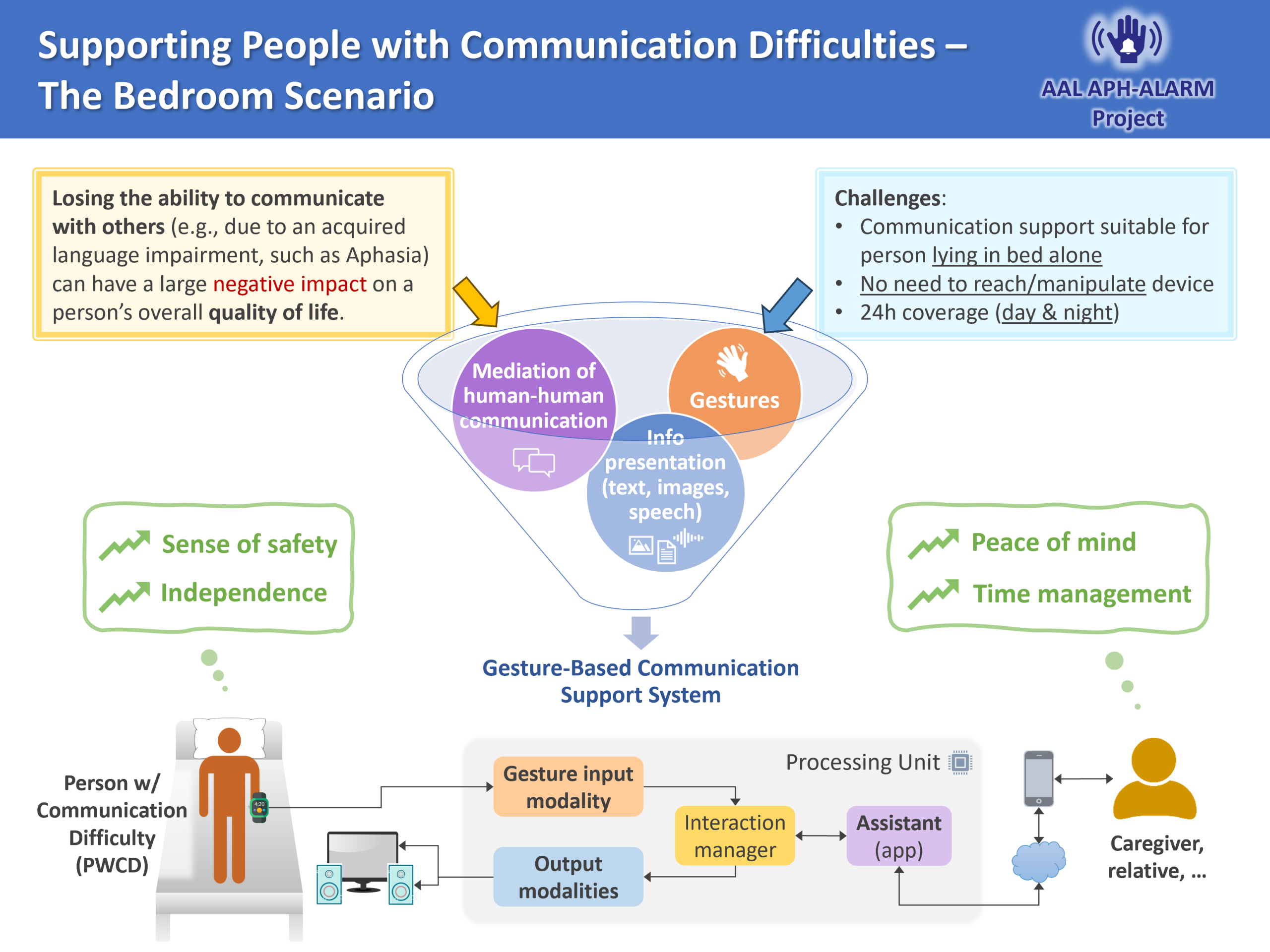
Communication difficulties can profoundly impact a person’s overall quality of life. However, most existing communication support systems are not designed for use while lying in bed alone, leaving a gap in assistive technology.
Introducing a Communication Support Solution for the In-Bed Scenario
In the scope of the APH-ALARM project, we developed a system specifically designed to support People with Communication Difficulties (PWCDs), particularly those with Aphasia, in bedroom settings.
✅ How does it work?
- A virtual assistant mediates communication between the PWCD and a caregiver by asking simple questions.
- The PWCD, wearing a smartwatch, can answer with gestures recognized using machine learning.
- Based on these responses, the system generates and sends messages to the caregiver.
- Information is presented to the PWCD through multiple output modalities to maximize understanding and accessibility.
Why does this matter?
This system has the potential to significantly improve quality of life by:
✔️ Increasing the sense of safety and autonomy of PWCDs.
✔️ Providing caregivers (formal and informal) with peace of mind and reducing their burden.
By leveraging AI, wearable technology, and multimodal interaction, we are taking a step towards more inclusive and accessible solutions for those who need them the most.
Authored by: Ana Patrícia Rocha
In collaboration with: Fábio Nunes, Afonso Guimarães, Luís Santana, Ilídio C. Oliveira, José Maria Fernandes, Miguel Oliveira e Silva, Ana Rita S. Valente, Samuel Silva, António Teixeira
Supported by: AAL (Active Assisted Living) Programme, Co-financed by the European Commission through the H2020 Societal Challenge: Health, demographic change, wellbeing; FCT (Portuguese Foundation for Science and Technology): Project APH-ALARM, IEETA
#AssistiveTechnology #Aphasia #AIForGood #Inclusion #HealthcareInnovation